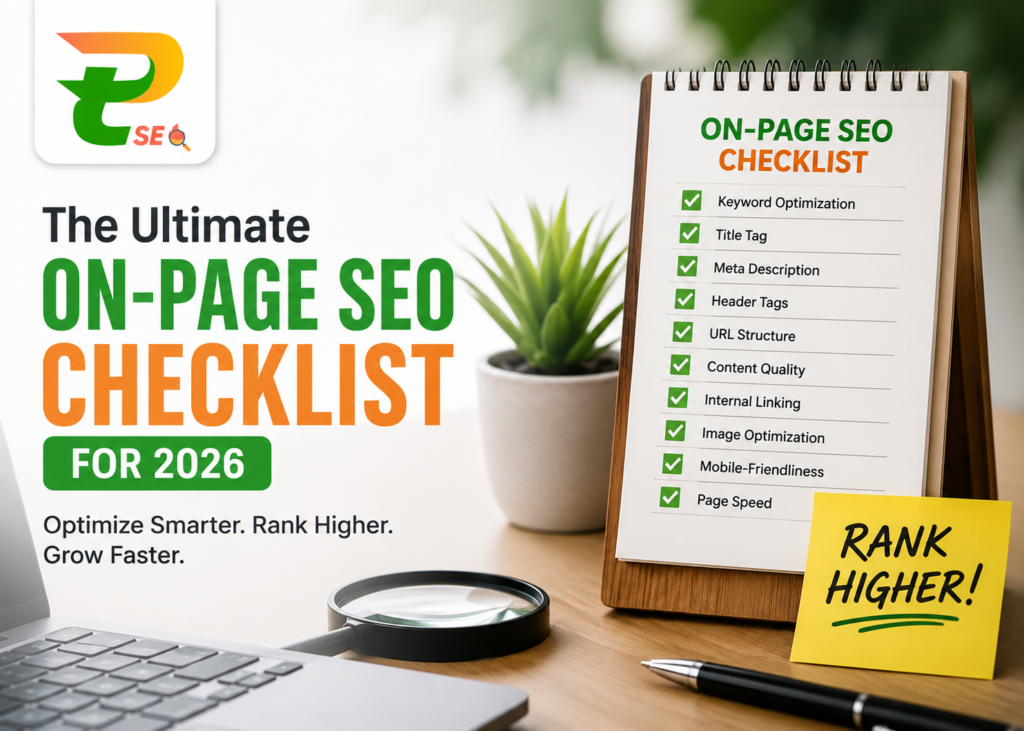
Search engines continue to refine how they evaluate websites, rewarding pages that deliver genuine value, excellent usability, and trustworthy information. Ranking on the first page is no longer about adding keywords or publishing lengthy content alone. Every page must satisfy user intent, load quickly, provide a smooth browsing experience, and communicate relevance clearly to search engines.
An effective On-Page SEO Checklist helps businesses maintain consistency while optimizing every important element of a webpage. Whether you manage a corporate website, an eCommerce platform, a local business, or a content-driven website, following a structured optimization process improves visibility, user engagement, and conversions.
At The Perfect SEO, we believe that successful optimization begins with a strong foundation. Each webpage should be created for people first while giving search engines the signals they need to understand content accurately. This checklist highlights the essential practices that matter most for 2026.
Table of Contents
ToggleWhy On-Page SEO Still Matters
Many businesses invest heavily in advertising, backlinks, and social media marketing while overlooking their own website. Without proper on-page optimization, even the strongest marketing campaigns struggle to deliver long-term results.
On-page SEO directly influences:
- Organic visibility
- Search relevance
- User experience
- Crawl efficiency
- Conversion rates
- Engagement metrics
- Brand credibility
Search engines evaluate hundreds of signals from individual pages before deciding where they belong in search results. Every optimized page becomes another opportunity to attract qualified visitors.
Start with Search Intent
Every successful page begins with one important question:
What does the visitor expect to find?
Search intent has become one of Google’s strongest ranking signals. Before writing any page, identify whether users are looking for:
- Information
- Services
- Products
- Comparisons
- Solutions
- Pricing
- Contact details
When your page satisfies the exact intent behind the search query, visitors stay longer, interact more, and convert at higher rates.
Instead of creating content around keywords alone, focus on solving real problems.
Build Every Page Around One Primary Topic
One page should focus on one primary subject.
Trying to rank a single page for multiple unrelated topics often creates confusion for both users and search engines.
For example, if the page targets On-Page SEO Checklist, every heading, paragraph, image, and internal link should support that topic.
Avoid mixing unrelated discussions like:
- Technical server configurations
- Social media marketing
- Paid advertising
- Graphic design
Maintaining topical focus increases relevance and improves rankings.
Create Strong Title Tags
Your title tag remains one of the most important ranking factors.
A strong title should:
- Include the primary keyword naturally
- Stay under approximately 60 characters
- Be easy to read
- Encourage clicks
- Match user expectations
Poor example:
SEO Services SEO Company Best SEO Agency SEO Experts
Better example:
The Ultimate On-Page SEO Checklist for 2026
Titles should sound natural instead of appearing stuffed with keywords.
Write Compelling Meta Descriptions
Although meta descriptions do not directly improve rankings, they significantly influence click-through rates.
A high-performing description should:
- Explain the page clearly
- Include the primary keyword naturally
- Encourage users to visit
- Stay within recommended character limits
- Highlight user benefits
Think of your meta description as a short advertisement for your page.
Use Clean URL Structures
URLs should remain short, descriptive, and readable.
Example:
yourdomain.com/on-page-seo-checklist
Avoid URLs like:
yourdomain.com/page?id=4567&cat=98
Simple URLs help users understand page topics before clicking.
Organize Content with Proper Headings
Headings improve readability while helping search engines understand page structure.
Recommended hierarchy:
H1
H2
H3
H4 (when necessary)
Every page should contain one H1 heading.
Subheadings should divide information into logical sections rather than creating long blocks of text.
Readers scan pages before reading them completely.
Clear headings improve user engagement.
Place Keywords Naturally
Keyword placement remains important, but forced repetition harms readability.
Include your target keyword naturally in:
- H1
- Introduction
- One or two H2 headings
- Image alt text where appropriate
- URL
- Meta title
- Meta description
- Conclusion
Use related terms throughout the page instead of repeating the exact phrase excessively.
Natural writing consistently performs better than keyword stuffing.
Optimize Content Depth
Longer content does not automatically rank better.
Quality always outweighs quantity.
A successful page should:
- Answer important questions
- Cover supporting topics
- Remove confusion
- Provide actionable insights
- Keep readers engaged
Every section should add value.
Avoid filler paragraphs written solely to increase word count.
Improve Readability
Visitors rarely read every sentence.
They scan.
Improve readability by using:
- Short paragraphs
- Clear headings
- Bullet points
- Numbered lists
- Bold emphasis where necessary
- Simple language
- Logical transitions
Easy-to-read content encourages visitors to stay longer.
Optimize Images Properly
Images contribute to user experience and search visibility.
Every image should include:
- Descriptive filenames
- Optimized file sizes
- Relevant alt text
- Modern formats
- Responsive dimensions
Instead of:
IMG00056.jpg
Use:
on-page-seo-checklist-2026.jpg
Image optimization also supports accessibility.
Focus on Core Web Vitals
User experience continues to influence rankings.
Important performance signals include:
- Fast loading speed
- Visual stability
- Responsive interaction
- Mobile usability
Slow websites frustrate visitors and increase bounce rates.
Compress images, reduce unnecessary scripts, enable browser caching, and optimize server response times.
Every second matters.
Make Mobile Optimization a Priority
Most users browse using smartphones.
Every webpage should:
- Adapt to different screen sizes
- Display readable fonts
- Maintain clickable buttons
- Load quickly
- Avoid horizontal scrolling
Mobile usability directly affects engagement and search performance.
Responsive design is no longer optional.
Strengthen Internal Linking
Internal links connect related pages while helping search engines discover website structure.
Benefits include:
- Better crawling
- Higher engagement
- Improved authority distribution
- Increased page views
Link naturally to supporting pages whenever they provide additional value.
Avoid adding internal links solely for SEO purposes.
Every link should help the visitor.
Add External References Carefully
Linking to authoritative sources can improve trust when additional evidence is needed.
Use external links only when they genuinely help readers.
Choose reliable sources with strong reputations.
Broken or outdated links should be removed during regular website maintenance.
Optimize Anchor Text
Anchor text should clearly describe the linked destination.
Instead of:
Click here
Use:
Read our local SEO strategies
Descriptive anchor text improves accessibility while helping search engines understand page relationships.
Use Schema Markup
Structured data helps search engines interpret content more accurately.
Useful schema types include:
- Organization
- Local Business
- FAQ
- Product
- Service
- Breadcrumb
- Review
- Article
- Event
Schema can improve visibility by increasing eligibility for enhanced search results.
Optimize for Featured Snippets
Featured snippets often capture significant search traffic.
Increase your chances by:
- Answering questions directly
- Using concise definitions
- Creating numbered steps
- Adding comparison tables
- Organizing information clearly
Search engines prefer structured answers.
Refresh Existing Pages Regularly
Search engines reward freshness when information evolves.
Review pages periodically to:
- Update statistics
- Replace outdated screenshots
- Improve formatting
- Expand useful sections
- Fix broken links
- Add new insights
Small improvements often produce noticeable ranking gains.
Build Trust Through EEAT
Google evaluates content quality using principles centered around:
- Experience
- Expertise
- Authoritativeness
- Trustworthiness
Strengthen trust by including:
- Accurate information
- Real business details
- Clear contact information
- Author expertise
- Transparent policies
- Secure HTTPS connection
Trust signals influence both users and search engines.
Improve User Engagement
Visitors should find it easy to interact with your website.
Encourage engagement through:
- Clear navigation
- Fast loading pages
- Helpful visuals
- Logical page structure
- Relevant calls to action
- Easy contact options
Positive user behavior often supports stronger long-term rankings.
Optimize Calls to Action
Every page should encourage visitors to take the next step.
Examples include:
- Request a consultation
- Contact our team
- Download a resource
- Schedule a meeting
- Explore related services
Calls to action should feel helpful rather than aggressive.
Check for Duplicate Content
Duplicate pages dilute ranking potential.
Review your website regularly to identify:
- Repeated service descriptions
- Similar location pages
- Duplicate product pages
- Multiple versions of the same URL
Each page should provide unique value.
Fix Broken Links
Broken links create poor user experiences.
Regularly audit your website to identify:
- Missing pages
- Incorrect redirects
- Expired resources
- Broken images
Maintaining healthy links improves both usability and crawl efficiency.
Monitor Crawlability
Search engines cannot rank pages they cannot crawl.
Review:
- Robots.txt
- XML sitemap
- Canonical tags
- Redirect chains
- Index status
Proper technical maintenance supports effective on-page optimization.
Optimize for Voice Search
Voice searches continue to grow.
Many users search using conversational questions.
Include:
- Natural language
- Question-based headings
- Concise answers
- Local information
- Conversational phrases
Voice-friendly content aligns with evolving search behavior.
Strengthen Local Relevance
Businesses serving specific regions should optimize local pages carefully.
Include:
- Business address
- Phone number
- Service areas
- Local landmarks
- Customer testimonials
- Google Business Profile consistency
Strong local signals improve regional visibility.
Track Performance Consistently
Optimization never ends after publishing.
Monitor:
- Organic traffic
- Keyword rankings
- Click-through rates
- Bounce rates
- Conversion rates
- User engagement
- Indexed pages
Regular analysis identifies opportunities for continuous improvement.
Common On-Page SEO Mistakes
Many websites lose rankings because of avoidable errors.
Common issues include:
- Keyword stuffing
- Thin content
- Missing headings
- Duplicate titles
- Poor mobile experience
- Slow loading speed
- Weak internal linking
- Missing image optimization
- Broken links
- Outdated information
Eliminating these mistakes often produces measurable improvements without creating entirely new pages.
How The Perfect SEO Helps Businesses Succeed
At The Perfect SEO, every optimization decision is based on user experience, search intent, technical excellence, and measurable business growth.
Our team evaluates every webpage carefully to identify opportunities that improve visibility, increase qualified traffic, and strengthen conversion performance. Rather than relying on outdated tactics, we focus on sustainable SEO strategies aligned with modern search engine expectations.
Whether your business operates locally, nationally, or internationally, applying a structured On-Page SEO Checklist creates a stronger digital presence that supports long-term success.
Final Thoughts
An effective On-Page SEO Checklist is more than a collection of optimization tasks. It creates consistency across every page, improves user satisfaction, strengthens technical quality, and helps search engines recognize relevance with greater confidence.
Businesses that continuously refine their pages, prioritize user experience, maintain technical accuracy, and publish valuable content position themselves for stronger organic growth throughout 2026 and beyond. Small improvements across multiple optimization areas often produce significant long-term gains, making on-page SEO one of the most valuable investments for sustainable search performance.
FAQs
What is an On-Page SEO Checklist?
An On-Page SEO Checklist is a structured list of optimization tasks that helps improve webpage quality, search visibility, user experience, and overall rankings by focusing on elements within the website itself.
Why is an On-Page SEO Checklist important in 2026?
Search engines increasingly prioritize user experience, page quality, mobile performance, and relevance. Following a checklist ensures every page meets modern ranking expectations and remains competitive.
How often should I review my On-Page SEO Checklist?
Review your website at least every three to six months or whenever significant search engine updates occur. Regular audits help identify outdated content, technical issues, and optimization opportunities.
Does on-page SEO improve rankings without backlinks?
Strong on-page SEO can significantly improve rankings, especially for low-competition and long-tail keywords. However, combining quality on-page optimization with authoritative backlinks generally delivers the best long-term results.
How can The Perfect SEO improve my website's on-page optimization?
The Perfect SEO analyzes every aspect of your webpages, including content quality, keyword optimization, page structure, internal linking, technical performance, and user experience to create a stronger foundation for sustainable organic growth.